
Vintage Pulp Sci-Fi Covers, from early days to Golden Age
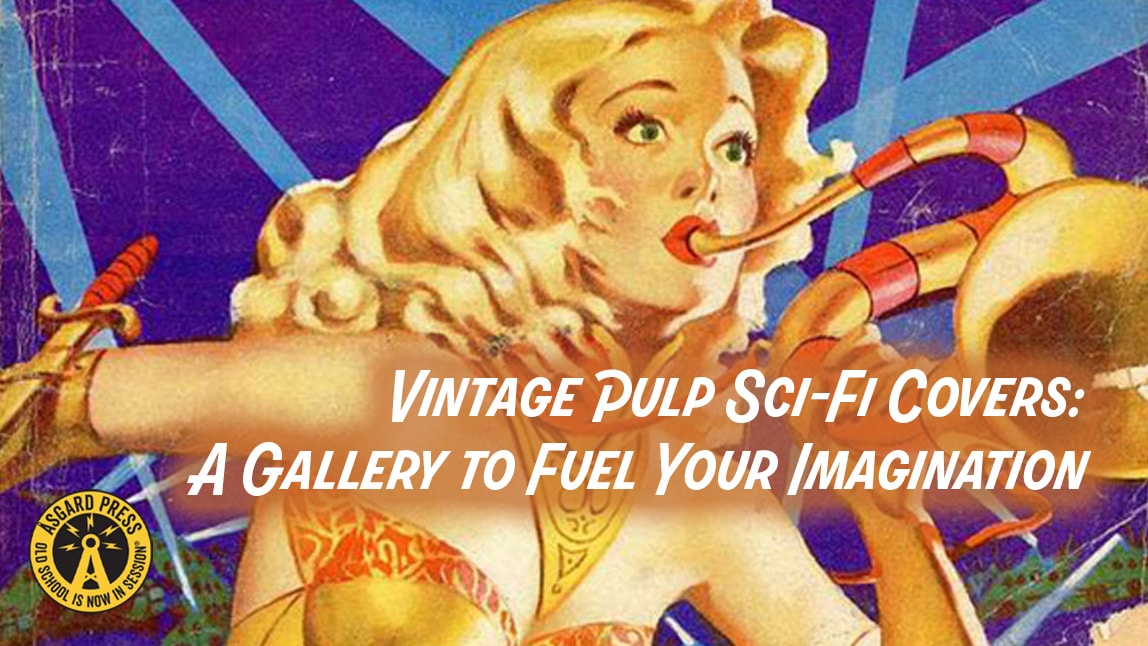
In 1926, inventor, author, and publisher Hugo Gernsback launched Amazing Stories, the first magazine devoted to the genre of science fiction. Other publications soon followed, populating newsstands with colorful and fantastic cover art, serving up eye candy for readers ready to immerse themselves in tales of space wars, heroic planetary travelers, beautiful maidens, and bug-eyed alien monsters. Artists such as Allen Anderson, who often depicted tough, gutsy, glamorous women, and Earle Bergey, credited with inventing the genre’s famous “brass brassiere,” provided artwork for these cheap, pulp magazines that remains unforgettable decades later.
Along with space damsels in brass bikinis, other sci-fi tropes were introduced on the covers of pulp magazines. Nearly 20 years before the first reported UFO sighting of a flying saucer, artist Frank R. Paul depicted the concept on the cover of the November 1929 issue of Amazing Stories. Humanoid robots and ray guns also made their debuts into pop culture through these inventive works of art.
In this gallery, we’ll explore a collection of a dozen dramatic vintage pulp sci-fi covers showcasing the future as we saw it many years ago.
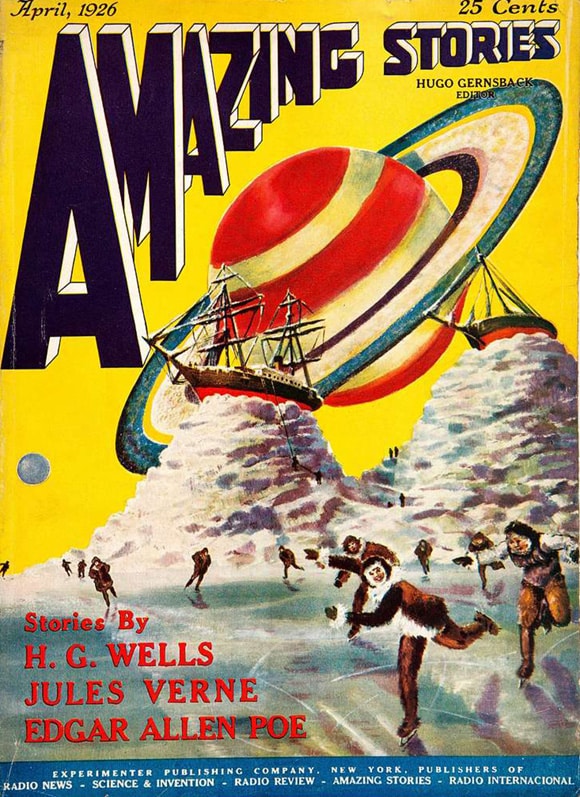
Amazing Stories, April 1926
This is the issue that started it all. Hugo Gernsback, an electronics and radio parts importer, published catalogs of his wares interspersed with fiction stories he called “scientifiction.” The launch of Amazing Stories, the first magazine dedicated solely to the genre of science fiction, began by republishing stories by authors such as H.G. Wells and Jules Verne, before employing writers to create original stories with scientific plot points and details. Our exploration of vintage pulp sci-fi covers begins here with this cover art by Frank R. Paul.
You can read more about Hugo Gernsback and his pulp sci-fi magazines in our blog post “Hugo Gernsback, Father of Science Fiction.”
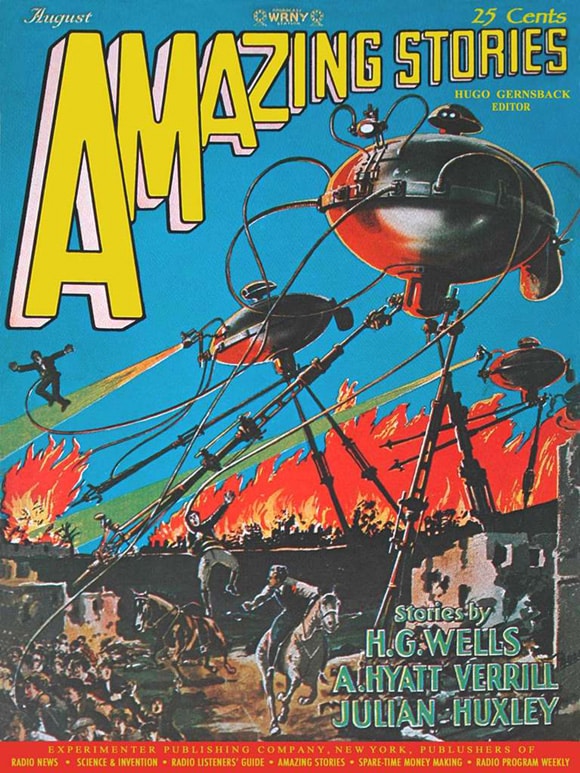
Amazing Stories, August 1927
In August of 1927, Amazing Stories Volume 2 No. 5 ran Part 1 of a serialization of “The War of the Worlds” by H.G. Wells. Originally serialized by Pearson’s Magazine and Cosmopolitan in 1897, “The War of the Worlds” tells the story of an invasion of Earth by evolutionarily superior alien beings from Mars. The tale was subsequently published in novel form in 1898. The August 1927 issue of Amazing Stories features artwork by Frank R. Paul, who created both the cover art and interior drawings for the story. Paul was a highly technical artist who excelled at depicting speculative technology, especially spacecraft and architecture.
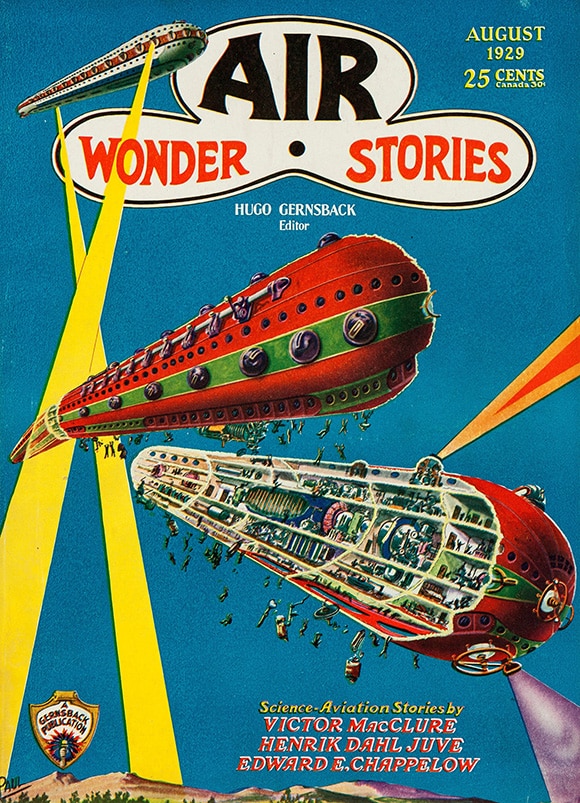
Air Wonder Stories, August 1929
The cover for the August 1929 issue of Air Wonder Stories was created by artist Frank R. Paul, Hugo Gernsback’s favored artist who contributed nearly every cover for Gernsback’s publications from 1914 onward. Using bold colors, dramatic compositions, and an innate ability to render highly inventive and fantastic scientific concepts, Paul has in many ways defined science fiction illustration. He painted the first science fiction cover for the very first science fiction magazine, Amazing Stories, in 1926 and his visions of spaceships, robots, and disc-shaped flying saucers established the tropes we still see in popular culture today. Paul’s artistic emphasis on machines over people set an on-going trend for the genre and even as sci-fi illustration becomes more sophisticated, Paul’s influence endures.
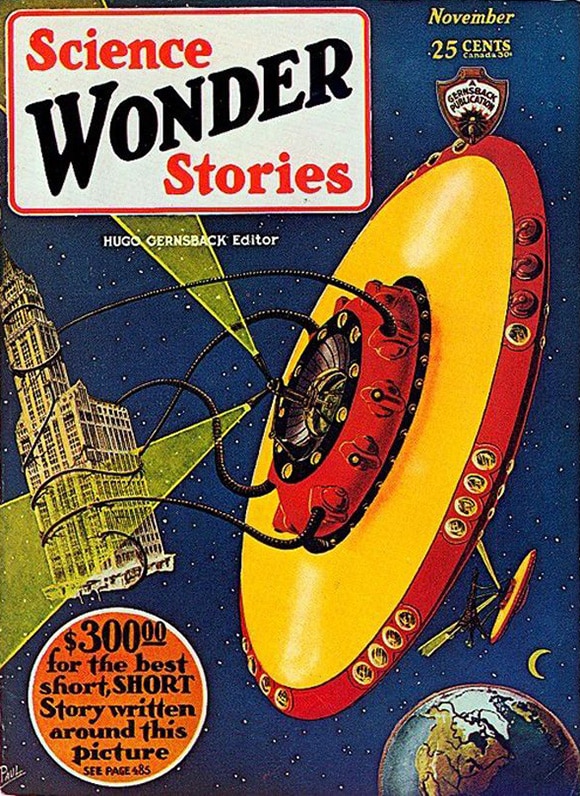
Science Wonder Stories, November 1929
Science Wonder Stories, another of Hugo Gernsback’s sci-fi publications, gave artist Frank Paul more opportunities to explore his artistic imagination and flair for illustrating inventive, futuristic spacecraft. The November 1929 issue is one of the earliest visual examples of a “flying saucer,” designed from Paul’s own creative mind. The flying saucer became an iconic image of science fiction, establishing the one of the genre’s earliest tropes. Twenty years later, when the first publicly reported sightings of UFOs began appearing in media, the descriptions of those unknown crafts distinctly resembled Paul’s own designs.
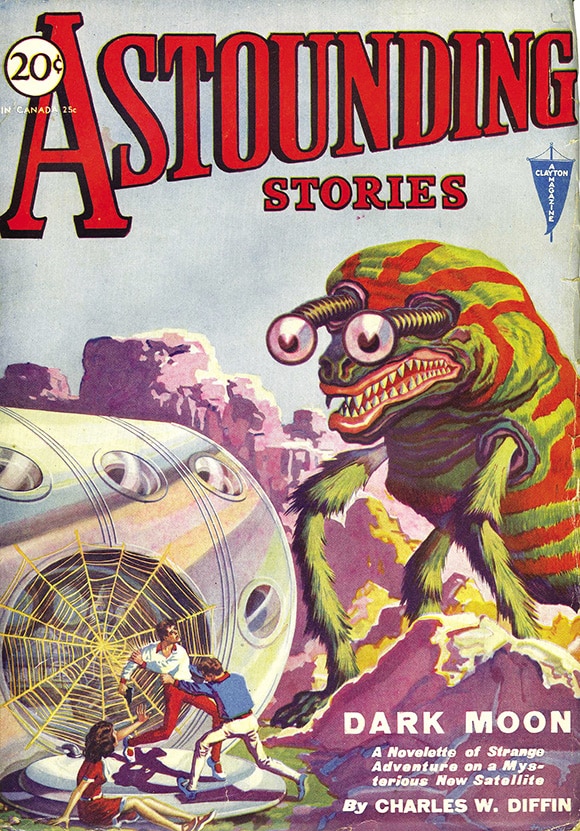
Astounding Stories, May 1931
By the 1930s, science fiction had firmly established itself as a genre within pulp magazines. For the first three years of its publishing existence, Astounding Stories was owned by Clayton Magazines and is probably most notable for the remarkable cover art created for each issue by Hans Waldemar Wessolowski, who signed his work “Wesso.” As an artist, Wesso excelled at depicting fantastic landscapes, spacecraft, and alien beings. The cover for the May 1931 issue is one of the earliest examples of what would become popularly known as a “bug-eyed monster,” a trope that would be especially common on the dramatic covers of pulp sci-fi in the 1950s. Astounding Stories was sold to Street & Smith in 1933, and the editorial reins fell into the hands of John W. Campbell in 1937. Campbell’s technology-focused vision for science fiction transformed the genre and launched its Golden Age.
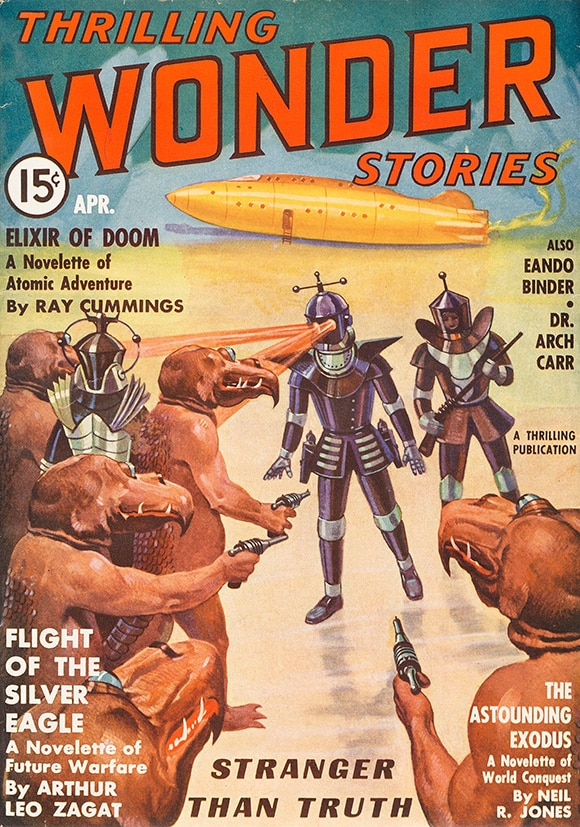
Thrilling Wonder Stories, April 1937
Wonder Stories, a pulp sci-fi magazine published by Hugo Gernsback in the early 1930s, was taken over in 1936 by publisher Ned Pines who owned the “Thrilling” line of pulps, with magazines covering many genres, such as Western, romance, adventure, and crime. Pines re-branded the pulp with his Thrilling imprint and changed its direction away from high-minded, science-based storytelling and leaned into dramatic, sensationalist content aimed at a more juvenile audience. Under editor Mort Weisinger, who eventually joined DC Comics as the editor of Superman comics, the writers for Thrilling Wonder Stories followed a formula of fast-paced action and adventure that created an escapist fantasy for eager readers during the Great Depression. The cover art for the April 1937 issue by Howard V. Brown echoes many of the visual tropes established by earlier artists such as Paul and Wesso, depicting bug-eyed monsters and a humanoid robot.
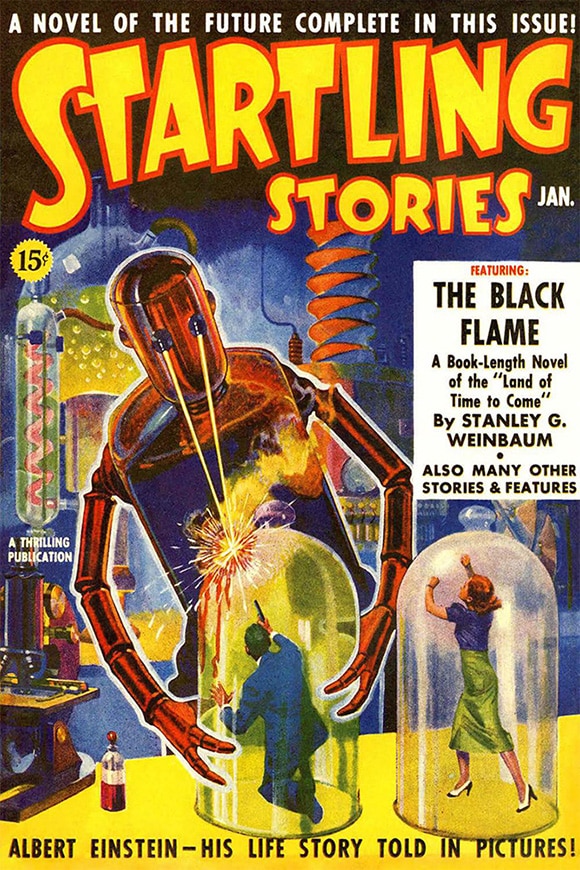
Startling Stories, January 1939
January 1939 saw the release of the first issue of Startling Stories, a companion series to Ned Pines’ Thrilling Wonder Stories. Startling Stories ran a complete novel in every issue, alongside short stories and reprints from Gernsback’s original Wonder Stories. In keeping with Pine’s editorial formula, Startling Stories was juvenile in nature, printing space opera and fantasy content, and became one of the most popular sci-fi magazines of the era, especially with young readers. The cover art for this first issue was created by Howard V. Brown, with a humanoid robot shooting rays from the eyes, very similar to his 1937 cover art for Thrilling Wonder Stories.
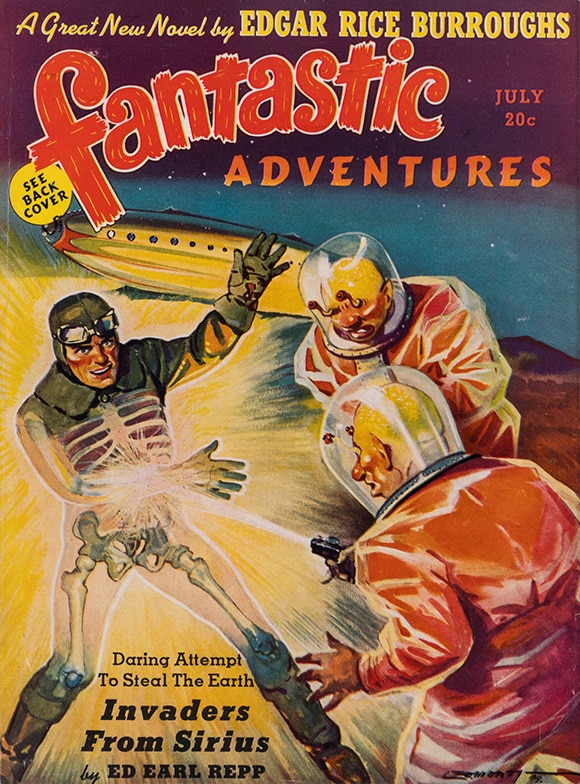
Fantastic Adventures, July 1939
Published by Ziff-Davis, Fantastic Adventures combined the literary genres of fantasy and science fiction, launched as a companion to Amazing Stories, Hugo Gernsback’s original sci-fi magazine that had been purchased from Teck Publications by Ziff-Davis in 1938. Fantastic Adventures was considered lighter in tone than many other sci-fi publications, with more fanciful stories that were mostly contributed by a handful of house writers. The cover for the 1939 issue was created by Leo Moray, who had a talent for rendering imaginative aliens and for conveying the visceral emotions of characters caught in fantastic situations. The energy of Moray’s compositions attracted the eye of many a young fantasy and sci-fi fan at newsstands.
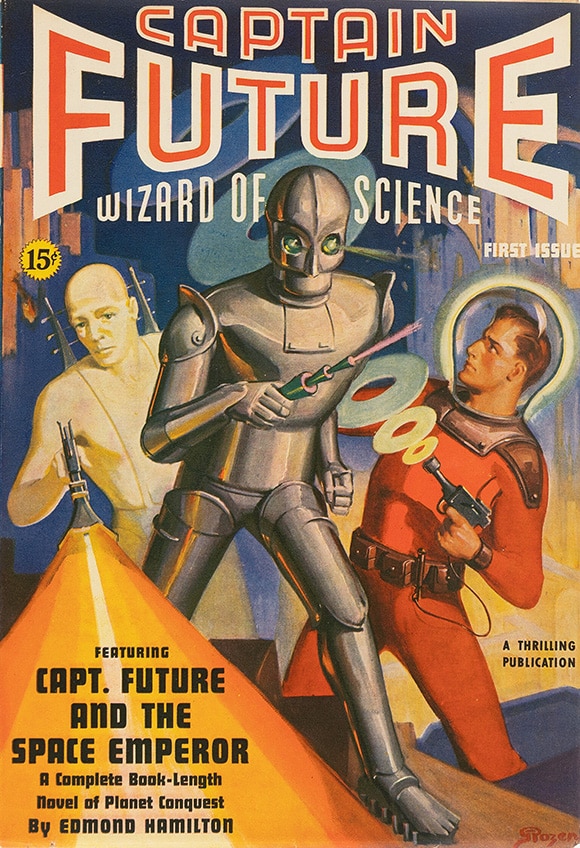
Captain Future, Winter 1940
Captain Future debuted with the Winter 1940 issue, another magazine in the stable of Ned Pines at Better Publications. Captain Future was a “hero pulp,” with each issue featuring a novel centered around Cam Newton, a space opera hero who traveled through space as a scientist-adventurer. Most of the Captain Future novels were written by author Edmond Hamilton, accompanied by shorter stories that targeted a juvenile audience. Though hero pulps were common during the format’s heyday, Captain Future was the only hero featured in the pulp science fiction genre. The cover for this premier issue was created by George Rozen, who is perhaps best known for his cover work for The Shadow, a detective and mystery hero pulp. Rozen’s cover art is characterized by its cinematic presentation, bold color palettes, and dramatic perspective.
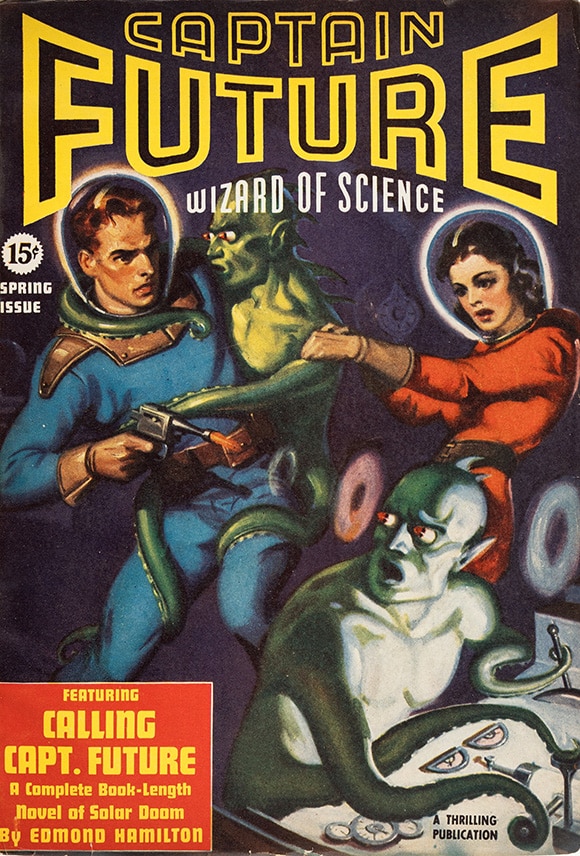
Captain Future, Spring 1940
For its second issue, Captain Future battles the evil Dr. Zarro in Edmond Hamilton’s novel “Calling Captain Future.” The universe portrayed within the pages of Captain Future was bright, optimistic, and full of planets and moons burgeoning with life. Captain Future used scientific inventions and gadgets to fight evil and right wrongs in a morally unambiguous atmosphere, with comedic relief provided by his sidekicks, the robot Grag and the shapeshifting alien Otho. The Spring 1940 cover art was provided by the great Earle Bergey, one of the defining artists of the Golden Age of pulp science fiction. Bergey’s sci-fi cover art followed a highly effective formula summarized within the industry as “Bim, BEM, Bum,” faithfully presenting a damsel (Bim), a bug-eyed monster (BEM), and a brawny, square-jawed hero (Bum).
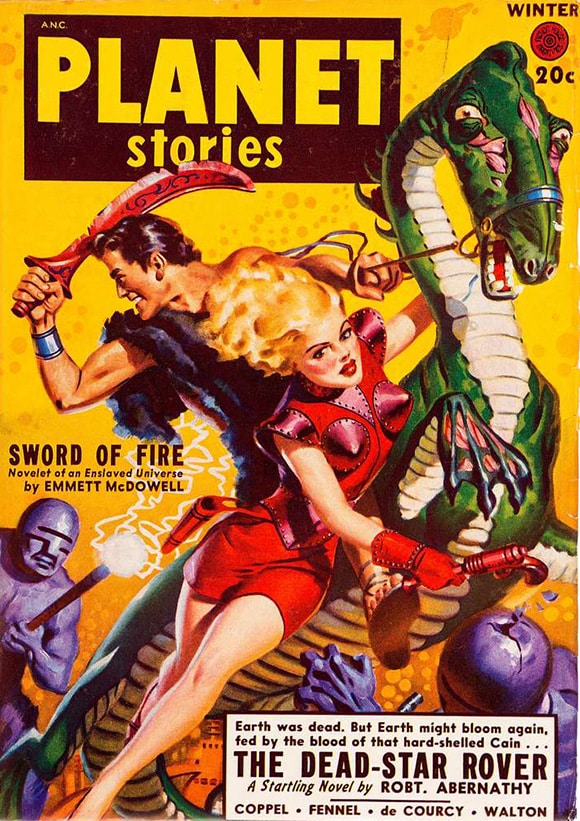
Planet Stories, Winter 1949
Planet Stories, another pulp sci-fi magazine known for its melodramatic space opera content, ran from 1939 to 1955 and was published by Fiction House. Though aimed at a more low-brow audience, Planet Stories nevertheless obtained some work from well-known science fiction authors such as Ray Bradbury, Isaac Asimov, and regular contributor Leigh Brackett who often wrote about heroines who held their own against menacing threats. The cover art for Planet Stories often favored a “pinup” look, featuring space maidens in revealing clothing that contrasted with heavily equipped heroes in astronaut-style suits. Artist Allen Anderson’s artwork for the Winter 1949 cover centers a heroine whose attributes are decoratively armored while she is nonetheless ready to defend both herself and her male companion with her trusty ray gun.
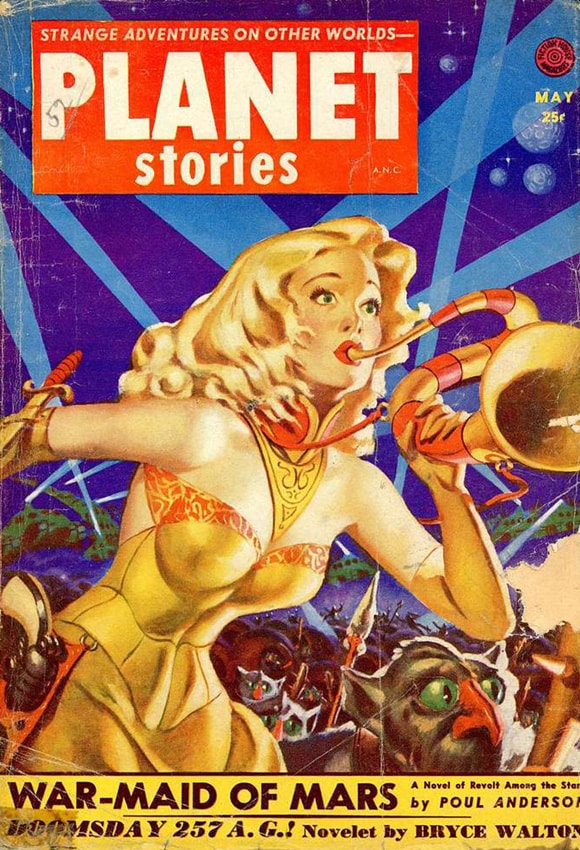
Planet Stories, May 1952
The May 1952 cover of Planet Stories, depicting the story “War-Maid of Mars” by Poul Anderson, has become iconic for its encapsulation of the Golden Age of pulp science fiction. A heavily armed, pinup style heroine rallies her alien minions for battle, exuding both glamour and fierceness. Her adventurous energy summarizes the drama of “sword and planet” space opera. Created by Allen Anderson, the original art for this cover is also famous for surviving the Fiction House fire, when employees burned the publisher’s stockpile of cover art after the company went out of business. Science Fiction Hall of Fame artist Kelly Freas visited the Fiction House offices shortly before they closed, demanding payment for his own work. In lieu of cash, he accepted a handful of Anderson’s original paintings as payment. Anderson’s painting of the War-Maid of Mars sold in 2008 to a private collector for over $38,000.
Interested in seeing more vintage pulp sci-fi covers? We’ve curated 13 fantastic otherworldly covers for our 2027 Vintage Sci-Fi Deluxe Calendar, designed with perforated images that fit standard frames so you can display your favorites long after the year is over.